
Why Your Old Microblading Turned Grey (And What to Do About It)
You looked amazing when you walked out of your microblading appointment. The color was warm, the strokes were defined, and for a few months you barely thought about your brows at all. That was the point.
Then something shifted. Slowly, over months or years, that warm brown color started pulling cool. Now your brows look flat, faded, or worse — they have a distinctly grey or bluish cast that no amount of brow pencil quite covers. You are not imagining it, and you are definitely not alone. It is one of the most common things we hear from new clients who come to Haven in Minnetonka looking for a fix.
Here is what is actually happening, and more importantly, what you can do about it.
The science behind the grey shift
Microblading uses pigment, not ink. That distinction matters more than most people realize. Cosmetic pigments are formulated to fade over time — that is intentional, because nobody wants permanently dark brows forever — but the way they fade is not always predictable.
Most microblading pigments are built on a base color. Warm browns are typically created using a combination of red, yellow, and brown pigments. The problem is that red and yellow molecules are smaller and tend to break down and absorb into the body faster than the remaining cooler pigment. What is left behind is the undertone — often a grey, blue, or ashy residue that sits in the skin long after the warmer tones have faded away.
A few other factors accelerate or worsen this:
Pigment placed too deeply. The deeper the pigment, the more it tends to shift. Shallow, precise placement fades more cleanly.
Multiple refresh sessions. Each time brow work is refreshed on top of old pigment, layers build up beneath the skin. Eventually you are not looking at one session worth of color — you are looking at years of accumulated pigment, all fading at different rates.
Skin undertone mismatch. A pigment that looked warm on the color chart can pull cool on certain skin undertones, especially as it fades.
Sun exposure. UV light degrades pigment faster and can cause color shifts, particularly in the warmer tones that give brows their natural look.
The warmer pigment breaks down first. What is left behind is the undertone — a grey or bluish residue that lingers long after the color you wanted has gone.
Why covering it up rarely works
The instinct when brows start shifting color is to get them refreshed — to go back in and add warmer pigment on top. And sometimes that works, if the underlying pigment has faded enough and the shape is still good.
But if there is significant grey or blue residue still sitting in the skin, adding warm pigment over it is a bit like painting over a dark wall with a light color. The base bleeds through. Your artist works hard to create something warm and natural, but by the time it heals, you are fighting against what is already there. The result tends to look muddy, uneven, or darker than intended — and after a few more sessions you end up with a buildup that becomes increasingly difficult to correct.
This is the situation where most of our laser removal clients find themselves. They are not here because they made a bad decision years ago. They are here because they kept trying to fix something that needed a different approach entirely.
What laser removal actually does
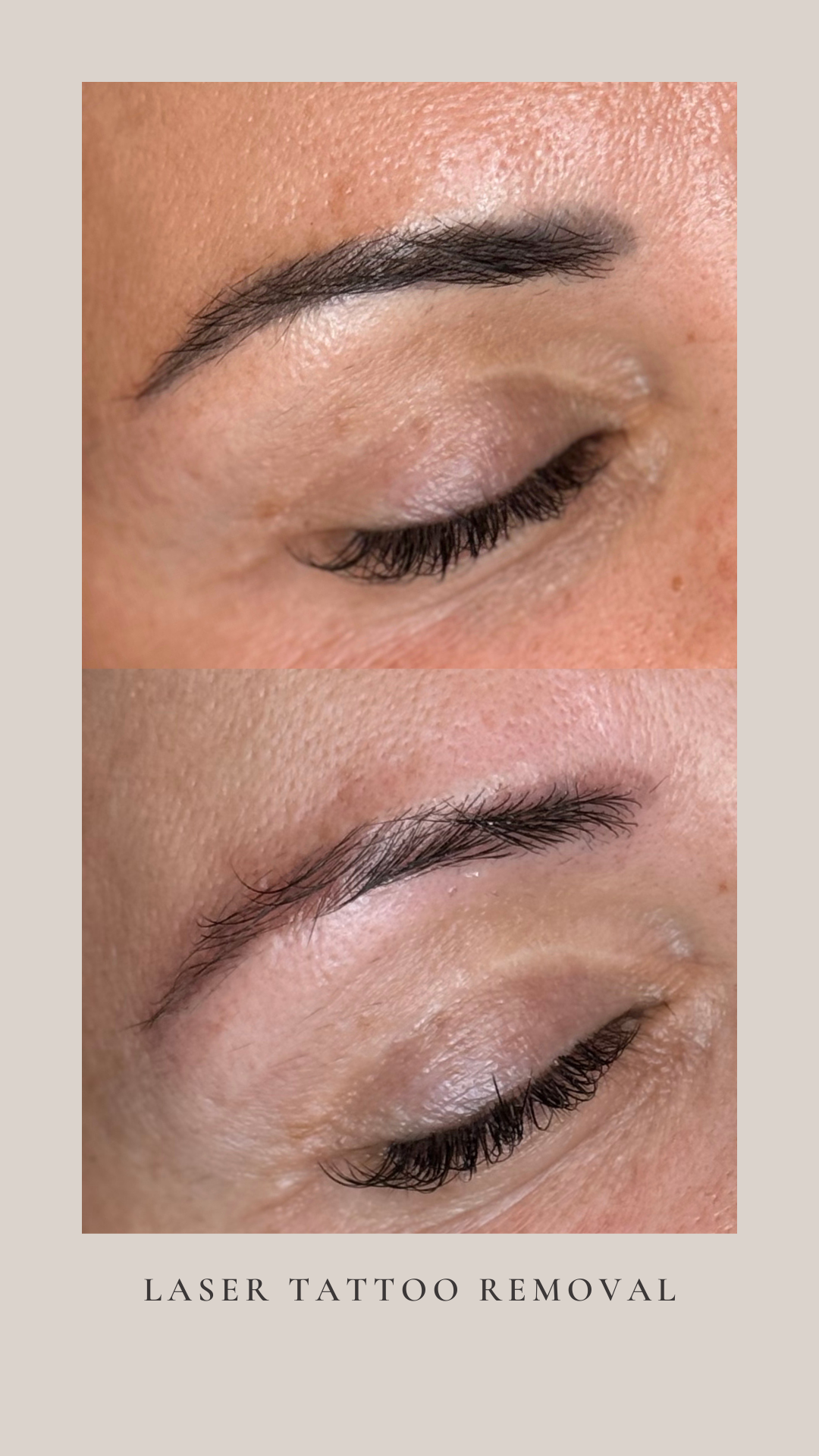
Laser brow removal uses targeted pulses of light energy to break down the pigment particles sitting beneath your skin. Those particles are absorbed and cleared by your body's immune system over the weeks following each session, gradually lightening the brow until the color is faded enough for a clean fresh start — or gone entirely, if that is the goal.
The treatment itself is quick. Most sessions take under fifteen minutes. There is some redness and mild sensitivity for a day or two, and then the fading happens gradually over the following six to eight weeks as your body does the work. Most clients need one to three sessions before the slate is clean enough to move forward with new brow work, though that varies based on how saturated the original pigment is and how old it is.
What makes this different from trying to refresh or cover the existing brows is simple: you are starting from a clear foundation. When your artist places new pigment into skin that has been properly cleared, it heals truer to color, retains better, and looks far more natural than anything placed on top of existing work.
At Haven in Minnetonka, our laser removal sessions start at $200, and our Reset + Refresh Package combines unlimited removal sessions with a full Nano Realism Brow appointment so you can go straight from old brows to new brows without navigating two separate processes.
You are not here because you made a bad decision. You are here because you kept trying to fix something that needed a different approach entirely.
What comes after laser removal
Once the old pigment has faded, this is where things get genuinely exciting. The brow landscape has changed significantly since most of our laser clients had their original work done. The techniques available now are more precise, more natural-looking, and longer-lasting than what was possible five or ten years ago.
Nano Realism Brows, the signature technique at Haven, use a fine machine needle to place individual hair strokes with a level of precision and softness that a manual microblading blade cannot replicate. Each stroke is mapped to follow the exact direction and spacing of your natural brow hairs, so the result looks genuinely indistinguishable from a real brow — not drawn-on, not flat, not obviously done. The technique works for every skin type, including oily skin that often gave clients trouble with traditional microblading, and the results last two to four years.
If you have been living with brows that have never quite looked right, the combination of laser removal and Nano Realism Brows is the most direct path to a result that finally does.
Is laser removal right for you?
Laser removal is a good option for almost anyone dealing with grey or discolored microblading, a shape they have outgrown, or old brow work that has become visually heavy after multiple sessions. A consultation is always the right first step — your artist will look at your brows, assess how much pigment is remaining, and give you an honest picture of how many sessions you might need and what results are realistic.
A few things to know before you book:
Sessions are spaced six to eight weeks apart to allow your body time to clear the treated pigment between appointments.
You will want to wait eight to twelve weeks after your final removal session before starting new brow work. This ensures your skin has fully healed and any residual pigment has finished clearing.
Sun protection is important throughout the process. UV exposure can interfere with how your skin clears the pigment and increase the risk of discoloration.
The fading is gradual — you will not see the full effect of a session until six to eight weeks after it. This is normal and expected.
The bottom line
Grey or ashy microblading is not a personal failure or a flaw in your skin. It is an almost inevitable outcome of how older pigment formulas break down over time, and it is something that can absolutely be corrected. The process takes a little patience, but the result — brows that finally look like yours — is genuinely worth it.
If you are in the Minneapolis area and have been quietly frustrated by how your brows have aged, come in and talk to us. We have helped a lot of clients in exactly this situation, and we have a clear, straightforward process for getting you to the other side of it.
Ready for a fresh start?
Haven Beauty Collective offers laser brow removal and Nano Realism Brows at our studio in Minnetonka, MN.
Book a consultation at havenbeauty.com | 14729 Excelsior Blvd, Minnetonka, MN · 612.399.6557